
Project Worthmore
Project Worthmore is a Denver nonprofit that supports refugees as they rebuild their lives. While volunteering with their English Language Program, I identified a critical operational challenge: matching volunteers with participants was entirely manual. I designed and led the creation of an internal matching platform that structured these constraints into a system capable of proposing compatible matches for coordinators to review.
The Challenge
Before this system existed, matching was performed manually using spreadsheets and coordinator memory. Coordinators had to cross-reference numerous variables to determine whether two people were compatible — a process that was difficult to scale as the program grew.
With 50–100 active participants at any given time, creating a single successful match could take up to an hour. Because so much information lived in notes or coordinator memory, the process was fragile and dependent on individual knowledge.
With 50–100 active participants, creating a single successful match could take up to an hour — and the process depended entirely on coordinator memory.
Designing the Matching System
Rather than treating matching as a simple scheduling task, the solution was designed as a multi-variable compatibility system that narrows possible pairings and proposes the most viable matches for coordinators to review. Instead of replacing the coordinator's judgment, the tool dramatically narrowed the list of possible pairings.
Designing Better Data
The matching system could only be as good as the data feeding it. The original intake process relied on free-text fields and coordinator notes — information that was difficult to standardize or compare across participants. Redesigning the intake forms meant converting subjective observations into structured, queryable fields that the compatibility engine could actually use.
Structured dropdowns replaced free-text notes, enabling the engine to score spoken and written fluency separately.
Binary toggles capture sensitive preferences as hard constraints — the system never proposes a match that violates them.
The availability grid captures time slots in a format the engine can directly intersect with volunteer schedules — no manual comparison needed.
Standardized location options feed directly into the distance calculation, replacing coordinators' mental maps of who lives where.
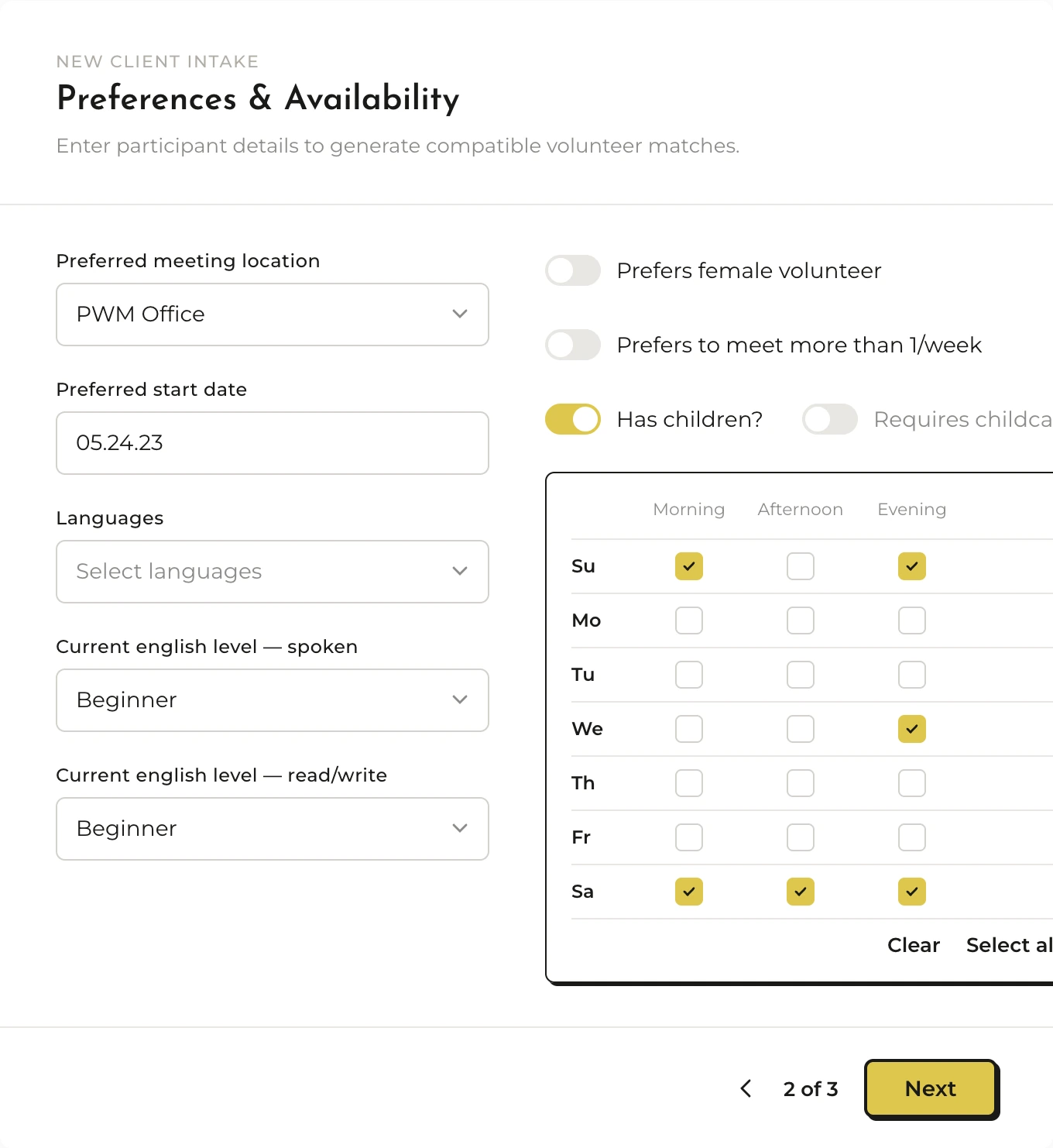
The matching system could only be as good as the data feeding it. The original intake process relied on free-text fields and coordinator notes — information that was difficult to standardize or compare across participants. Redesigning the intake forms meant converting subjective observations into structured, queryable fields that the compatibility engine could actually use.
Coordinator Workflow
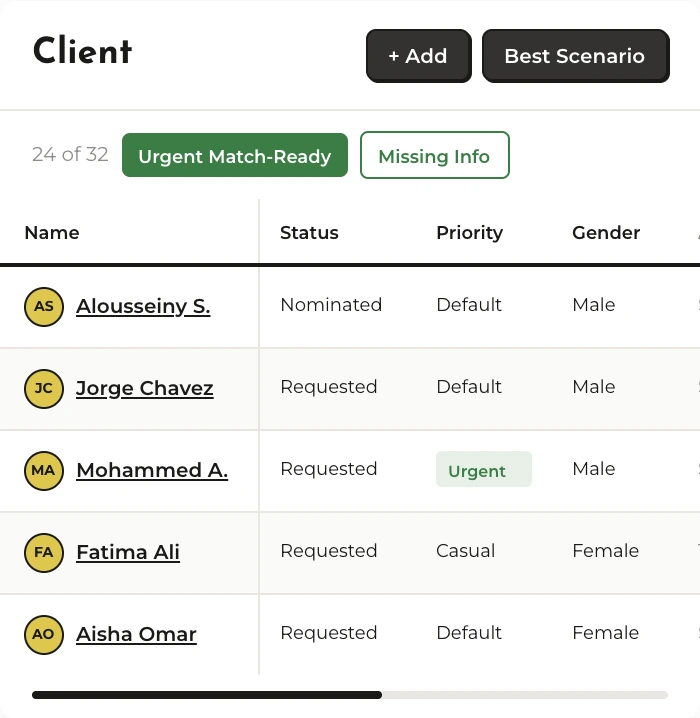
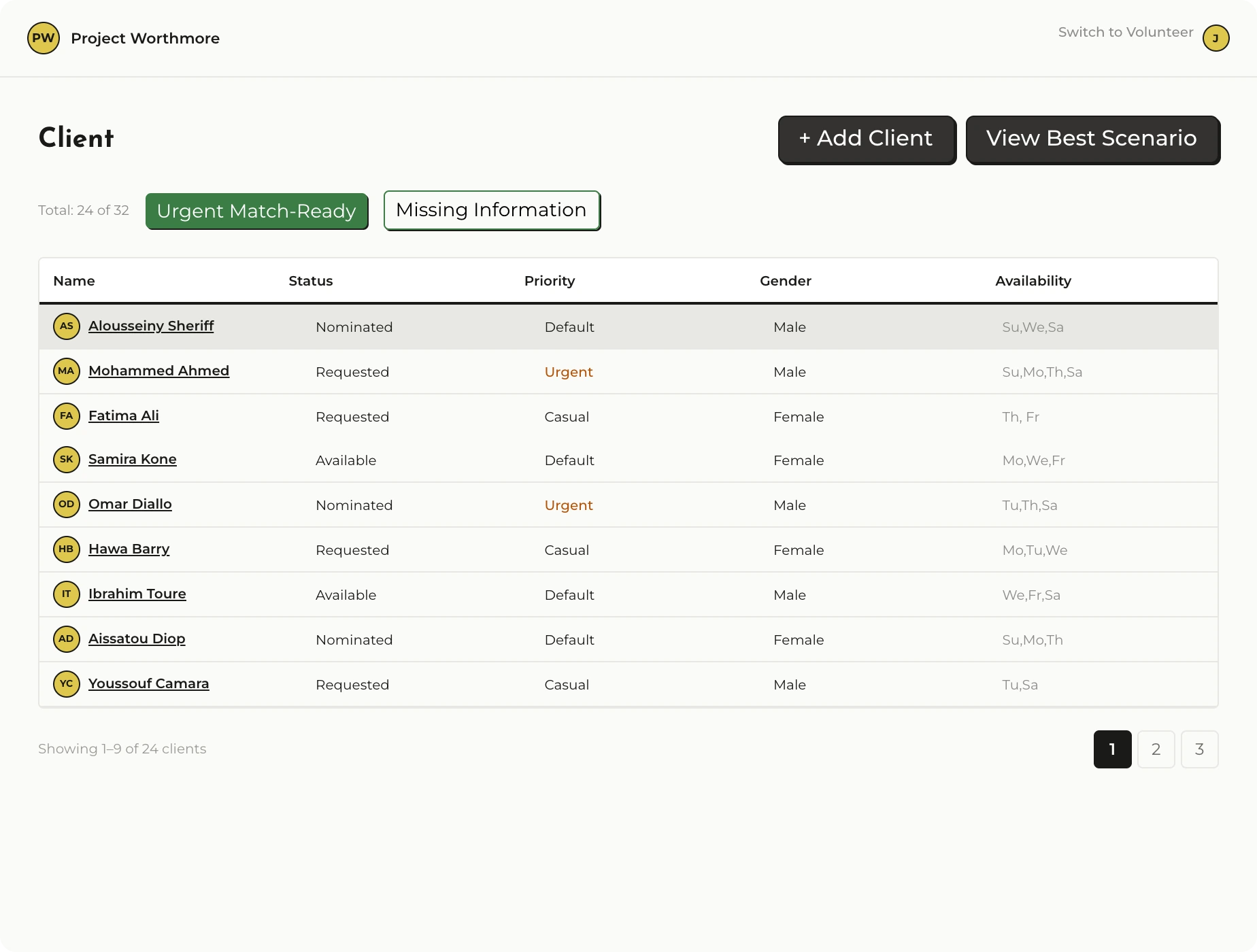
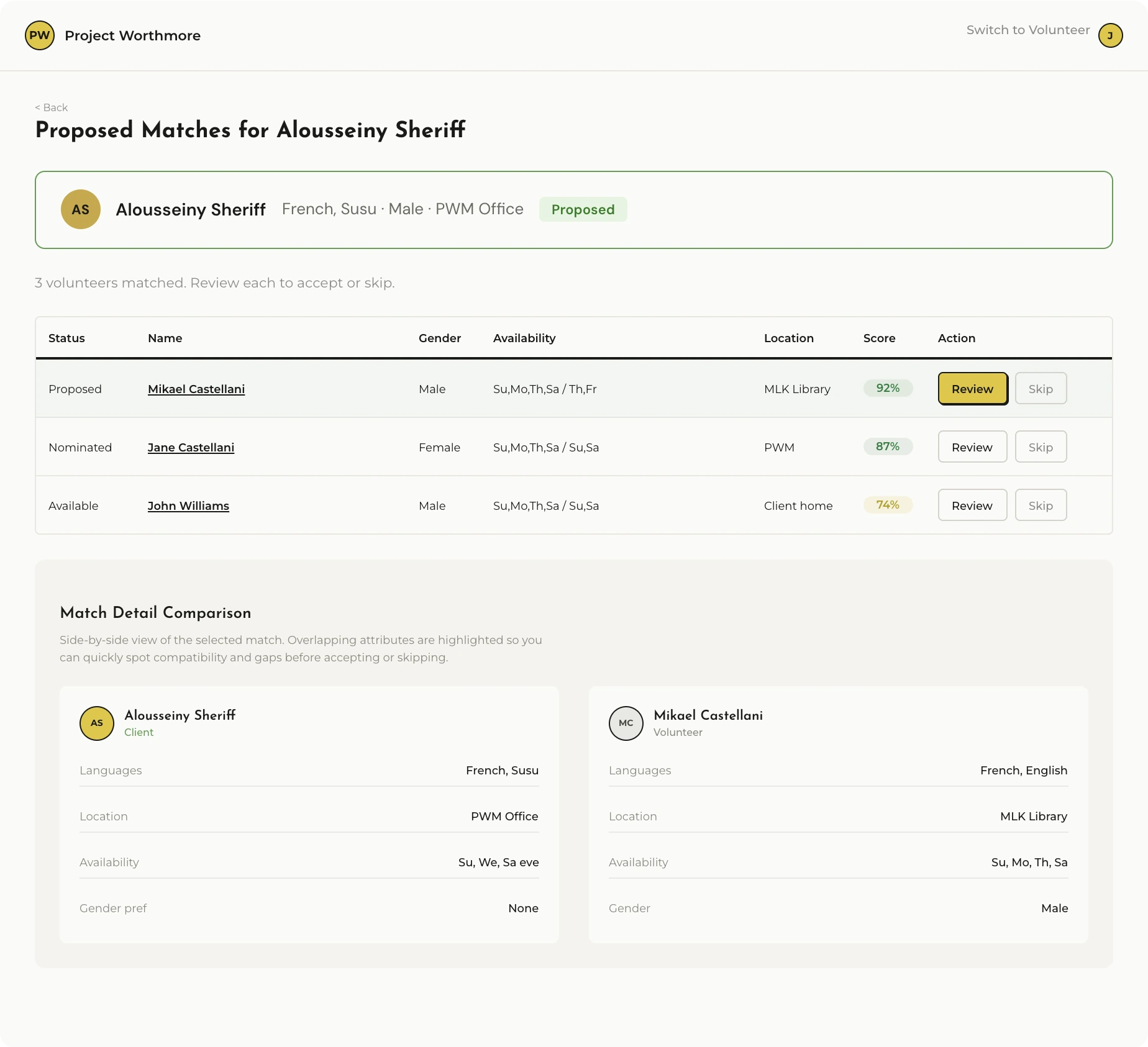
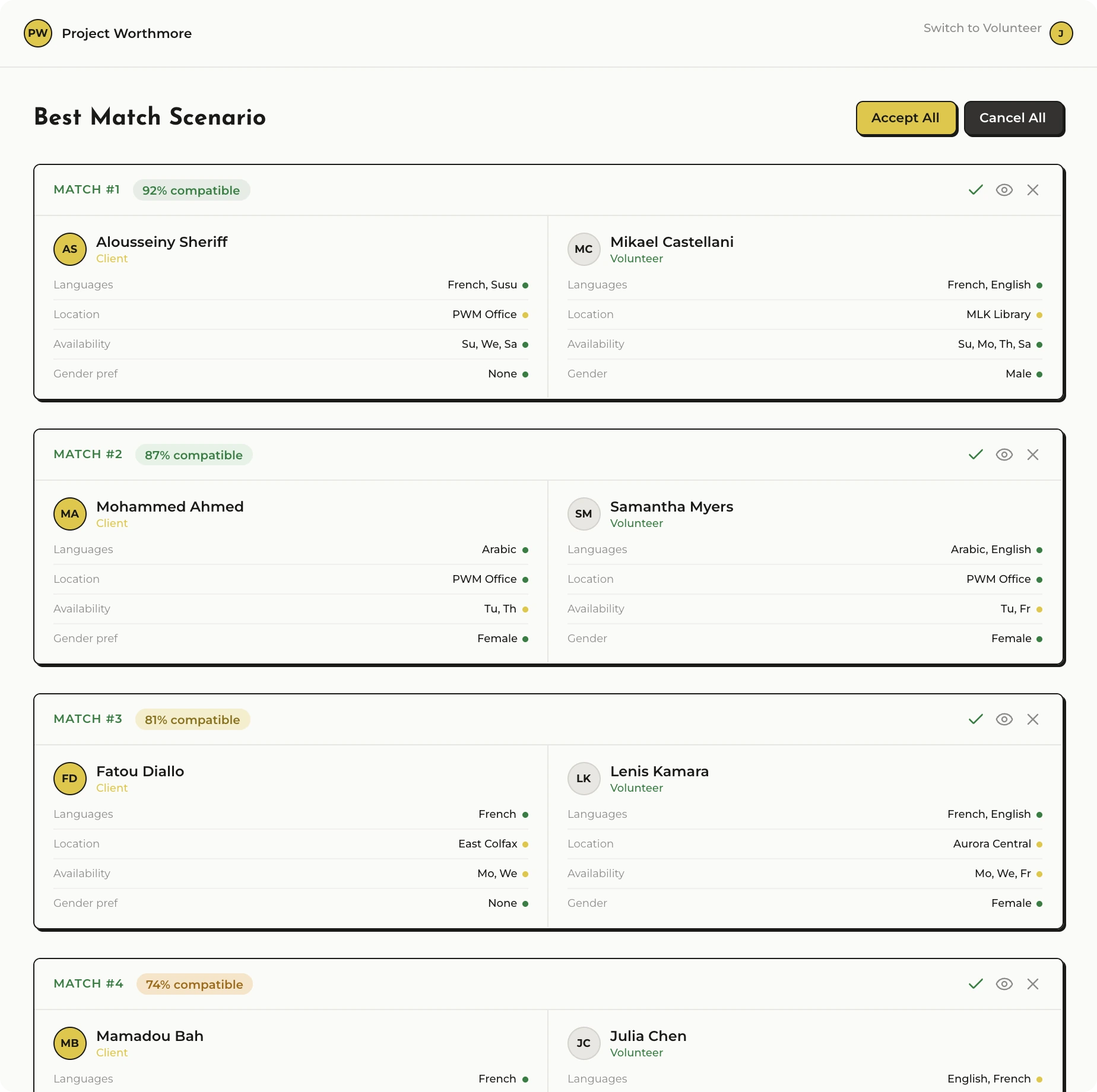
With structured data flowing into the system, coordinators no longer needed to hold everything in memory. The review interface presented ranked matches side by side — surfacing compatibility scores, schedule overlaps, and potential conflicts so coordinators could make confident decisions in minutes instead of hours.
With structured data flowing into the system, coordinators no longer needed to hold everything in memory. The review interface presented ranked matches side by side — surfacing compatibility scores, schedule overlaps, and potential conflicts so coordinators could make confident decisions in minutes instead of hours.
All active clients at a glance with smart filters for urgency and completeness.
Ranked volunteer matches filtered by hard constraints and scored by compatibility.
System-optimized pairings across all clients with approve/reject actions.
Impact & Reflection
The system handles matching — coordinators review, not reconstruct. Every match freed 30–40 minutes to invest in the work only a human can do.
Coordinators shifted to deciding, not searching
Ranked matches surface automatically. Review and confirm — never build from scratch.
Hard constraints enforced automatically
Sensitive preferences — cultural compatibility, gender, schedule — never violated by a proposed match.
Capacity directed to 3 additional programs
DeLaney Community Farm, Yu Meh Food Share, and Understanding Neighbors — programs that needed coordinator presence, not paperwork.
“Before the system, matching volunteers and participants meant digging through spreadsheets and notes to remember all the details that make a partnership successful. The new platform surfaces compatible matches immediately and saves us an incredible amount of time.”
— Program Coordinator, Project Worthmore
Designing the form was designing the system.
The hardest problems on this project weren't interaction problems — they were data-modeling ones. Getting the intake structure right made every downstream decision possible.